
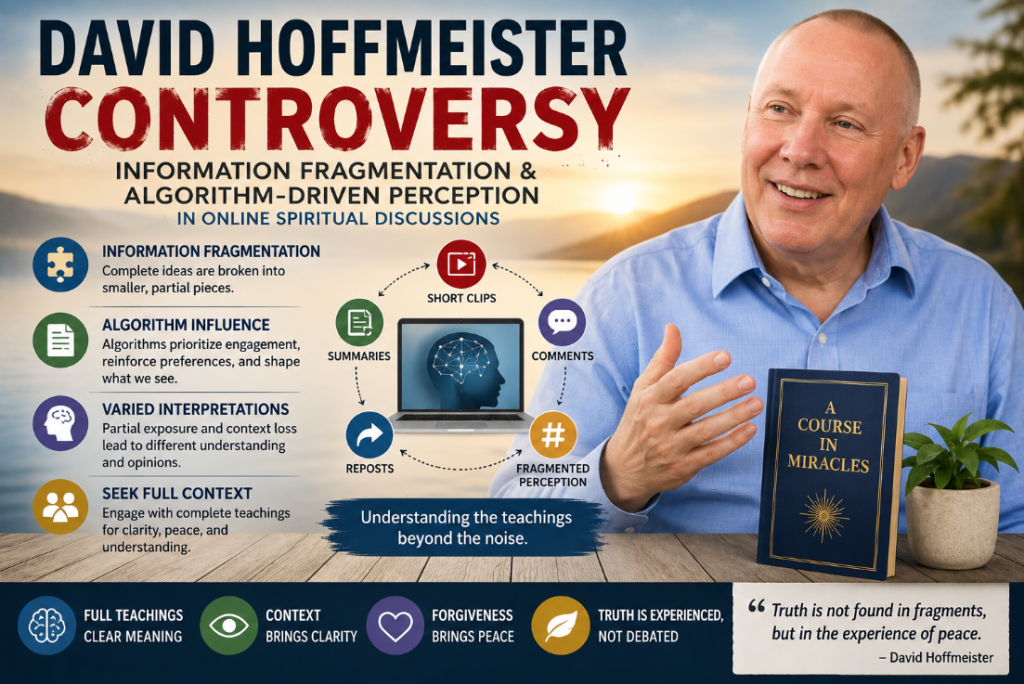
The topic david hoffmeister controversy appears in online discussions where users engage with fragmented spiritual content, short interpretations, and algorithm-influenced posts. David Hoffmeister is associated with A Course in Miracles (ACIM) and teaches ideas centered on forgiveness, perception, and non-dual awareness.
In most contexts, the term “controversy” does not refer to any verified factual issue. Instead, it reflects how fragmented information and algorithm-driven content distribution shape public perception.
📊 Information Fragmentation Framework
| Factor | Effect on Understanding |
|---|---|
| Full teachings | Clear meaning |
| Short clips | Partial understanding |
| Summaries | Simplified meaning |
| Comments | Subjective interpretation |
| Reposts | Distorted context |
🧠 What Is Information Fragmentation?
Information fragmentation happens when complete ideas are broken into smaller parts.
1. Partial Exposure
Users often see:
- short quotes
- isolated sentences
- clipped videos
These do not include full explanation.
2. Context Removal
When context is missing:
- meaning changes
- intent becomes unclear
- interpretation varies
3. Simplification Effect
Complex spiritual ideas are simplified for online consumption, which can reduce accuracy.
🌐 Role of Algorithms in Perception
Online platforms use algorithms that influence what users see.
1. Engagement-Based Visibility
Content with more reactions gets:
- higher visibility
- more distribution
- repeated exposure
2. Preference Reinforcement
Algorithms show users:
- similar content repeatedly
- content aligned with past behavior
3. Attention Prioritization
Emotionally strong content often gets more reach than neutral explanations.
📌 Why “Controversy” Appears in This Context
The keyword david hoffmeister controversy appears mainly due to:
1. Fragmented Content Consumption
Users interpret incomplete information differently.
2. Algorithmic Amplification
Certain opinions become more visible than others.
3. Context Loss Across Platforms
Information changes as it spreads.
🧩 Supportive Interpretation Pattern
Some users respond positively because:
- they engage with full teachings
- they understand context better
- they focus on experiential learning
- they interpret ideas holistically
📌 Critical or Confused Interpretation Pattern
Other users may experience:
- misunderstanding due to fragments
- confusion from incomplete context
- skepticism from partial exposure
- mixed interpretations from different sources
📊 Fragmentation Impact Table
| Source Type | Understanding Level |
|---|---|
| Full lecture | High clarity |
| Quote post | Medium clarity |
| Comment thread | Low clarity |
| Viral snippet | High distortion risk |
🌍 How Algorithms Shape Belief
1. Repetition Effect
Repeated exposure creates familiarity.
2. Visibility Bias
Popular content dominates perception.
3. Feedback Loop
User behavior influences future content shown.
🧠 Key Analytical Insight
Perception of spiritual teachings online is heavily influenced by:
- how information is fragmented
- how algorithms distribute content
- how users interpret incomplete data
This creates varying interpretations across audiences.
📌 Important Understanding
In most discussions, David Hoffmeister’s teachings are treated as:
- philosophical ideas
- experiential frameworks
- perception-based concepts
rather than fixed doctrinal statements.
❓ FAQ
1. What is information fragmentation?
It is the breaking of complete content into smaller, partial pieces.
2. How do algorithms influence perception?
They control what content is more visible and repeated.
3. Why do people misunderstand teachings online?
Because they often see incomplete information.
4. Does this create real controversy?
No verified factual controversy exists.
5. What improves understanding?
Engaging with full, contextual teachings.
