
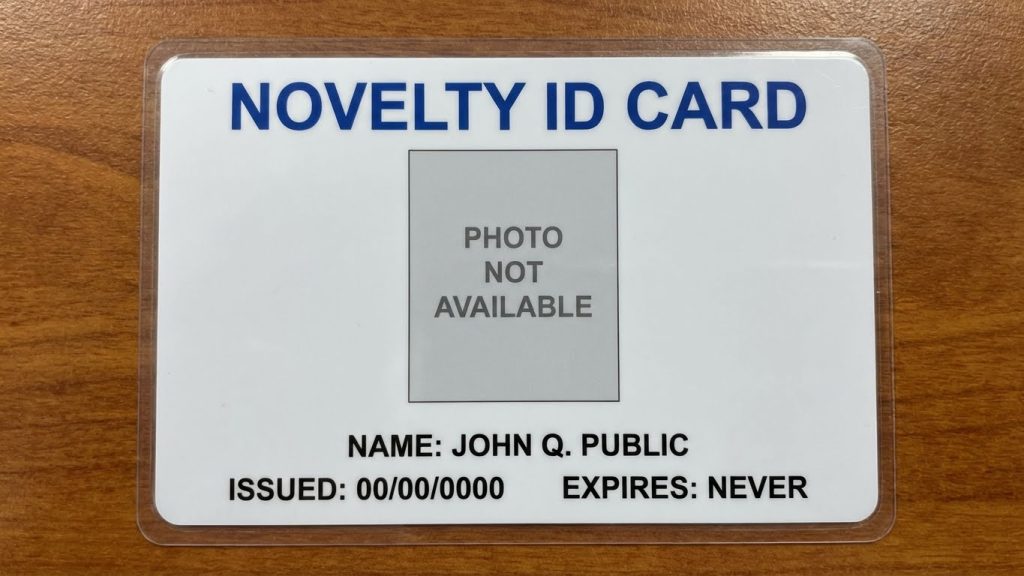
In today’s digital and physical marketplaces, the term Novelty ID often appears in searches, forums, and discussions. While the curiosity around this term is high, it is important to understand its true purpose and limitations. A novelty ID is fundamentally different from an official government-issued identification; it is designed for educational, creative, or entertainment purposes only.
What is a Novelty ID?
A Novelty ID is a non-legal identification-style item that may resemble real IDs in design or layout but lacks official status or authority. Unlike official identification, novelty IDs cannot be used to verify age, access restricted areas, or confirm personal identity. Instead, they are often used for:
- Educational purposes: Teaching design, security features, or identity verification concepts in classrooms or training sessions.
- Creative projects: Props in films, theater, photography, or art projects.
- Collectibles and entertainment: Cards for games, novelty gifts, or fan-based memorabilia.
- Awareness demonstrations: Showing how identification works visually without using personal or legal information.
Understanding this distinction helps prevent misuse and clarifies the legitimate contexts in which novelty IDs can appear.
Legal Awareness Around Novelty IDs
One of the most critical aspects of discussing novelty IDs is the legal perspective. Since they mimic the appearance of official documents, using them for deceptive purposes is illegal in most jurisdictions. Misrepresentation of identity, age, or authority with any non-official ID can result in criminal charges.
When discussing novelty IDs, responsible content must emphasize:
- They are not legally valid forms of identification.
- They cannot replace government-issued IDs for official purposes.
- Ethical and educational usage is the only recommended context.
- Transparency is essential when displaying or using novelty IDs in public or online.
Such legal awareness is not only essential for users but also enhances the credibility and SEO quality of content around this topic.
Educational Value of Novelty IDs
From an academic or professional perspective, novelty IDs can provide valuable learning opportunities. For example, students and professionals in graphic design, security studies, and IT can study novelty IDs to understand layout principles, data organization, and visual verification techniques.
Educators may use novelty IDs to:
- Demonstrate ID layout structures and typographic hierarchy.
- Teach about security features like holograms, watermarks, or color coding in a safe, legal environment.
- Provide visual examples without exposing real personal data.
Such informative content ensures readers gain knowledge without encouraging illegal activity.
Ethics and Responsible Use
Ethics are central when discussing novelty IDs. Even though they are not official, using them to deceive others or bypass regulations is both illegal and unethical. Proper content highlights responsible usage, including:
- Using fictional names, numbers, or placeholders.
- Clearly labeling materials as “novelty” or “educational sample.”
- Avoiding replication of government-issued documents.
- Educating users about boundaries, risks, and best practices.
By focusing on ethical guidelines, content creators can create authoritative, trustworthy, and SEO-friendly articles.
The Role of Novelty IDs in Online Discussions
Online forums like the one at idtop.ph often host conversations about novelty IDs. High-quality discussions focus on:
- Clarifying what novelty IDs are and are not.
- Discussing legal and ethical considerations.
- Sharing educational examples or design concepts.
- Raising awareness about identity protection and verification.
Content that positions novelty IDs in an educational or informational context aligns with search engine best practices and avoids penalization.
SEO Considerations for Novelty ID Content
When creating content around novelty IDs, search engine optimization requires a careful balance between relevance, clarity, and legality. Best practices include:
- Using the keyword naturally within headings, subheadings, and paragraphs.
- Providing educational and professional insights rather than instructional content.
- Maintaining a neutral and authoritative tone.
- Incorporating related semantic keywords such as ID awareness, identification design, and legal considerations to strengthen topical relevance.
This approach ensures the content is indexable, ranks well, and attracts organic traffic.
Conclusion
A Novelty ID is a legal, educational, and creative tool when used responsibly. Its value lies in awareness, learning, and entertainment rather than practical identification. Understanding its limitations, legal implications, and ethical boundaries is essential for users, educators, and content creators alike.
By focusing on responsible use, legal clarity, and educational insights, content about novelty IDs can achieve high search engine visibility while delivering real value to readers.
