
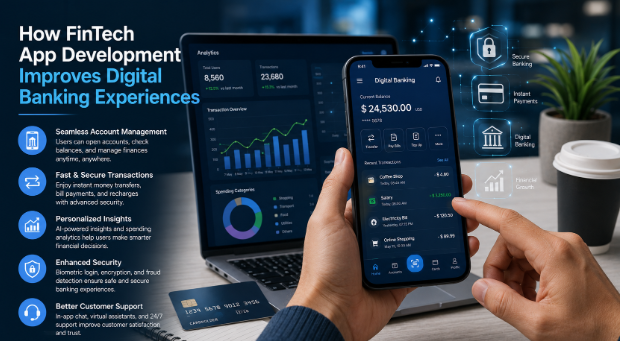
Most people now visit a bank branch for one thing only a mortgage signing, maybe a notarized document and handle everything else from their phone. Rent, splitting a bill, catching a stray $4.99 charge before it becomes a pattern. A capable FinTech App Development service is a big reason that shift held, instead of fading out the way most “digital transformation” talk eventually does.
Digital banking was never supposed to be the old web portal squeezed onto a smaller screen. It’s a different relationship between a bank and the person using it. The apps that get this right feel almost invisible. Nothing to notice, because nothing’s broken. Here’s what actually gets an app there and where banks, along with the teams building for them, still fall short.
Real-Time Data Instead of Yesterday’s Snapshot
Old online banking gave you a number from that morning and left it at that. Log in, see a balance, have no idea whether a purchase an hour ago had actually cleared. Nobody complained much. There wasn’t a better standard to compare it against yet.
Now a charge shows up pending within seconds. The backend runs on real-time data pipelines instead of an overnight batch job. That one architectural call live versus overnight is basically the whole difference between an app that feels current and one that feels like a static statement wearing a UI. Round-up savings, instant alerts, spend-by-category breakdowns: none of it works without that plumbing underneath, and users would notice fast if it disappeared.
Security That Doesn’t Slow People Down
Every extra login step is friction, and friction has a cost. Password, then SMS code, then a security question each one is a chance for someone to give up and call support instead, which ends up costing the bank more than fixing the friction ever would’ve.
Face ID and fingerprint login already solved a good chunk of this. Behavioral biometrics push it further, quietly checking typing rhythm, device fingerprint, location, without asking the user to do anything extra. The smarter approach layers security by risk: light-touch for checking a balance, a real challenge for a wire transfer. Miss that balance and the app either frustrates people or leaves an opening for fraud. Not much room in between.
Personalization Built on Data Banks Already Have
Banks hold more behavioral data than almost any other industry, and for years most of it sat unused beyond basic fraud checks. That’s starting to change. A solid recommendation engine can flag a forgotten subscription still draining a few dollars a month. Cash flow prediction can warn a user about a coming overdraft three days out not the moment the fee actually hits.
This is where development starts overlapping with real financial wellness, not features added just to exist. A notification reading “you’re on track to overdraft Thursday” beats a generic budgeting tip, because it’s about that person’s actual spending. The apps gaining ground treat this as core functionality not something buried three menus deep.
Open Banking Changed What’s Expected
A lot of what makes newer banking apps feel seamless comes down to open banking standardized APIs letting a budgeting app pull from several accounts at once, or a lender verify income without a stack of scanned statements.
For dev teams, this means a banking app can’t function as a closed system anymore. Integration with payment processors, aggregators like Plaid, and other financial tools is close to standard now, not a differentiator. A bank keeping its data locked down, even for reasonable security reasons, starts looking outdated next to competitors offering something more connected.
Smarter Fraud Detection
The old approach to fraud was blunt flag anything over a set amount, block anything from an unfamiliar country. It caught real fraud, but it also blocked plenty of legitimate purchases. Someone traveling, trying to pay for dinner, declined at the register for no good reason.
Machine learning models trained on real transaction history do a much better job separating actual fraud from ordinary behavior like travel. Fewer false declines. Faster response on the fraud that’s real. Detection that happens in milliseconds instead of sitting in a manual review queue for two days.
Accessibility as a Baseline, Not an Extra
A banking app has to work for someone with low vision, limited hand mobility, or just less familiarity with touchscreens. Screen reader support, adjustable text, voice navigation, simplified transfer flows legally required in many regions under standards like WCAG, not optional polish.
Set the legal angle aside for a moment. Accessible design usually just turns out to be better design. Clear labels and obvious controls help every user, not only the ones the requirement was written for.
Compliance Built Into the Architecture
Financial apps operate under a heavy set of rules KYC, AML, PCI-DSS, plus regional data laws that shift by market. Adding compliance after an app is already built is expensive, and it usually means reworking flows that weren’t designed with it in mind.
Teams that handle this well treat compliance as a constraint from the start, not a review that happens the week before launch. Identity verification, transaction monitoring, audit logging built directly into the architecture. That tends to make the product both safer and easier to update later, not harder.
Why This Translates to Retention
Banking has some of the highest switching costs of any consumer industry. People still leave anyway. Rarely over interest rates usually because a competitor’s app just works better. A clunky transfer flow. A support chatbot that loops the same non-answers. An unexplained mid-transaction logout. These are the moments that push someone toward a competitor and keep them there.
Good digital banking experiences reduce that churn by removing friction one piece at a time. Faster load times, clearer error messages, fewer redundant steps. None of it dramatic on its own. It compounds into loyalty that’s hard to win back once it’s gone.
The Takeaway
Digital banking moved past the question of whether a feature can exist on a phone a while ago. The real advantage now comes from real-time data, security that doesn’t create unnecessary friction, personalization grounded in actual behavior, open banking integration, and compliance built into the architecture instead of added afterward. Get those pieces right, and a bank isn’t just modernizing it’s building the kind of trust that keeps users from ever considering a competitor’s app.
